
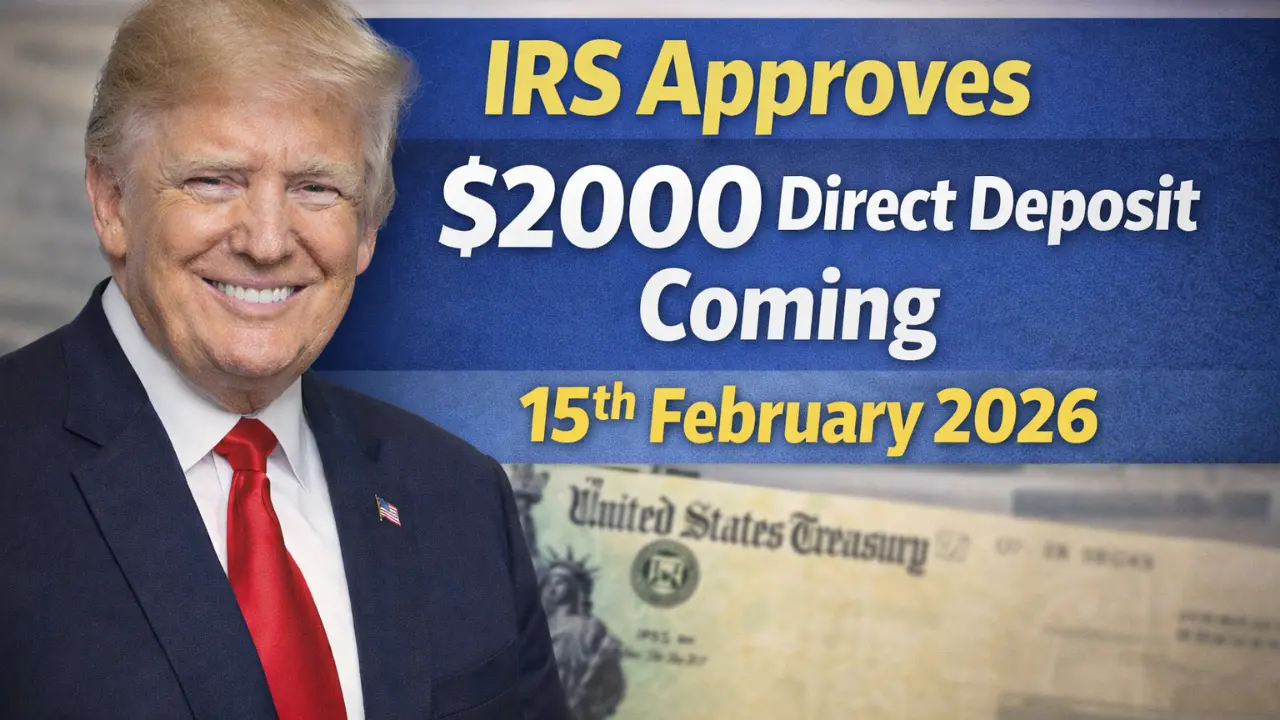
Claims circulating online say the Internal Revenue Service has approved a one-time $2,000 direct deposit to be sent to millions of Americans on 15 February 2026. As of February 6, 2026 the IRS has not issued a program announcement or legal authority to send a universal $2,000 payment. This article separates fact from rumor, explains how such a payment would be administered if it were authorized, outlines realistic eligibility scenarios, and tells you exactly how to check your status and protect yourself from scams.
What people are seeing online and why it matters
Social posts, news aggregation sites and a string of copycat web pages have amplified a short message: “IRS approves $2,000 direct deposit — money arrives Feb 15.” The message is simple, shareable and financially tempting. When unverified claims like this spread, they affect household budgeting, tax-filing behavior and vulnerability to fraud. Government payments require either congressional authorization or a clearly defined administrative program; the IRS cannot lawfully send mass payments outside those authorizing mechanisms.
The official position from the IRS (what we can confirm)
The IRS’s public news and press channels contain no release announcing a $2,000 direct deposit program scheduled for mid-February 2026. Routine IRS guidance about refunds and direct deposit remains in place — for example, the IRS notes that most refunds are issued within weeks after a correctly filed return — but there is no new stimulus program visible on the agency’s official pages as of February 6, 2026. If a federal payment program were authorized by Congress, the IRS would publish a clear implementation timeline and instructions on IRS.gov.
How a $2,000 payment would likely be structured (if it were authorized)
Below is a practical breakdown of how the federal government typically implements one-time payments, based on past precedent and administrative practice. This is a hypothetical framework — not confirmation — to help you understand the mechanics if Congress and the Treasury authorize such a payment.
| Step | Typical administrative action |
| Authorization | Congress passes a law (or an executive emergency program is used where legally permissible). |
| Funding & formula | Law defines funding source, per-person amount, and income/eligibility cutoffs. |
| Identification | IRS uses most recent tax returns (Form 1040) or Social Security/SSA records to identify recipients. |
| Delivery method | Direct deposit using bank account information on file, with checks or debit cards used for others. |
| Notification | IRS issues a press release, posts Q&A, and updates “Get My Payment” or equivalent portal. |
| Fraud controls | Identity matching, look-back verifications, and enhanced fraud detection are applied before disbursal. |
Who might qualify — realistic eligibility scenarios
If Congress were to authorize a $2,000 one-time payment, lawmakers typically choose one of these eligibility models:
- Universal payment to adults — every adult U.S. citizen or resident with a valid Social Security number (less common; highest cost).
- Income-phased payment — full payment for individuals under a chosen AGI threshold, with phase-outs above that range.
- Benefit-targeted payment — payments automatically routed to Social Security, VA, SSI, or other existing benefit recipients.
- Tax return–based payment — the IRS uses most recent tax returns to determine eligibility and direct-deposit routing.
Because authorization determines eligibility, check statutory language carefully if and when one appears.
Payment dates: what 15 February would mean in practice
The date “15 February 2026” being cited online is likely an arbitrary target chosen by rumor-makers. In past programs, implementation has taken weeks from authorization to first deposits. Even with expedited rules, steps that normally add time include finalizing recipient lists, running identity checks, and provisioning systems to queue millions of ACH transfers. Expect a program to publish a range of deposit dates (direct deposit window, then checks) rather than one single day. The IRS’s standard refund practices offer a guide: correctly filed returns typically result in refunds within about three weeks when direct deposit is used — but large-scale new programs often require additional lead time.
How the IRS would notify you and how to check your status
If an authorized payment is coming, the IRS will take the following steps:
- Publish a headline news release on IRS.gov and a Q&A page explaining eligibility and timeline.
- Update online portals (e.g., “Get My Payment” style tool) where you can check deposit status using SSN and ZIP.
- Send official notices by mail to recipients’ last known address; some recipients may see an IRS notice (CP-series) explaining the deposit.
- Do not expect unsolicited phone calls, text messages or emails from the IRS offering to speed up or confirm deposits — those are common scam vectors.
Fraud, scams and safety tips — what to watch for
Scammers exploit big-ticket rumors. If you get contacted in any of the following ways, treat it as suspicious:
- Requests to “verify” bank routing and account numbers via email or text.
- Messages that require fees or “processing charges” to release the payment.
- Links to unofficial websites that request your Social Security number, passwords, or bank login.
- Social posts promising an instant “claim” form to get your $2,000.
If you suspect fraud, do not click links. Go directly to IRS.gov for confirmation and report suspicious contact to the Treasury Inspector General for Tax Administration (TIGTA) or the FTC.
Quick checklist — what you can do today
- Confirm your direct-deposit bank info on your 2025 tax return or with the IRS when you file.
- File your 2025 tax return electronically and choose direct deposit to speed legitimate refunds.
- Sign up for official IRS notifications where available; monitor IRS.gov for authoritative updates.
Estimated fiscal scale (hypothetical) and broader impact
Below is a simple fiscal sketch to show scale if a $2,000 payment were universal for adult U.S. residents (this is illustrative math, not a budget estimate):
- U.S. adult population (approximate): 260 million
- If every adult received $2,000, gross cost ≈ $520 billion
- If limited to 150 million eligible taxpayers, gross cost ≈ $300 billion
Policymakers choose narrower eligibility or income phase-outs specifically to reduce these totals and target need. Large one-time payments have short-term stimulative effects on consumer spending but raise questions about funding sources, inflationary impact, and long-term fiscal tradeoffs.
Frequently Asked Questions
What if I see a message that says I must register to receive $2,000?
Do not register on any unofficial site. Official IRS programs that send automatic payments use tax return or benefit records — they do not require a separate registration on a random web page.
Will the IRS call me to confirm my bank account for the payment?
No. The IRS does not initiate contact by phone, text or email to request bank account details to send a payment. Official notices may arrive by U.S. mail.
If I filed a 2025 return, will the IRS use that data?
If a payment is enacted and the statute directs the IRS to use tax return data, the agency would typically use the most recently filed return on file. The enabling law would specify which tax year to use.
What if Congress approves a payment after Feb 15?
Implementation follows authorization. If approval comes after the rumored date, the Treasury and IRS will publish a schedule that may push first deposits later.
How long until I see a payment if I’m eligible?
Large federal programs usually announce an initial deposit window for direct deposits, followed by checks and other delivery methods. Timeframes vary depending on complexity and fraud checks.
Bottom line — what to remember
As of February 6, 2026 there is no official IRS program or announcement confirming a $2,000 direct deposit scheduled for February 15. The rumor is widespread but unverified. If Congress or the Treasury authorizes such a payment, official details (eligibility, timeline, and how to check) will appear on IRS.gov and via official communications. Until you see that confirmation, treat social posts and unsolicited messages with skepticism and protect your personal and banking information.

Hello i really need help with my bills and rent i hope we get 2,000 help with bills
We have never got a $2000 deposit